
Why Coherence Is Becoming the Defining Leadership Capability of the AI Era
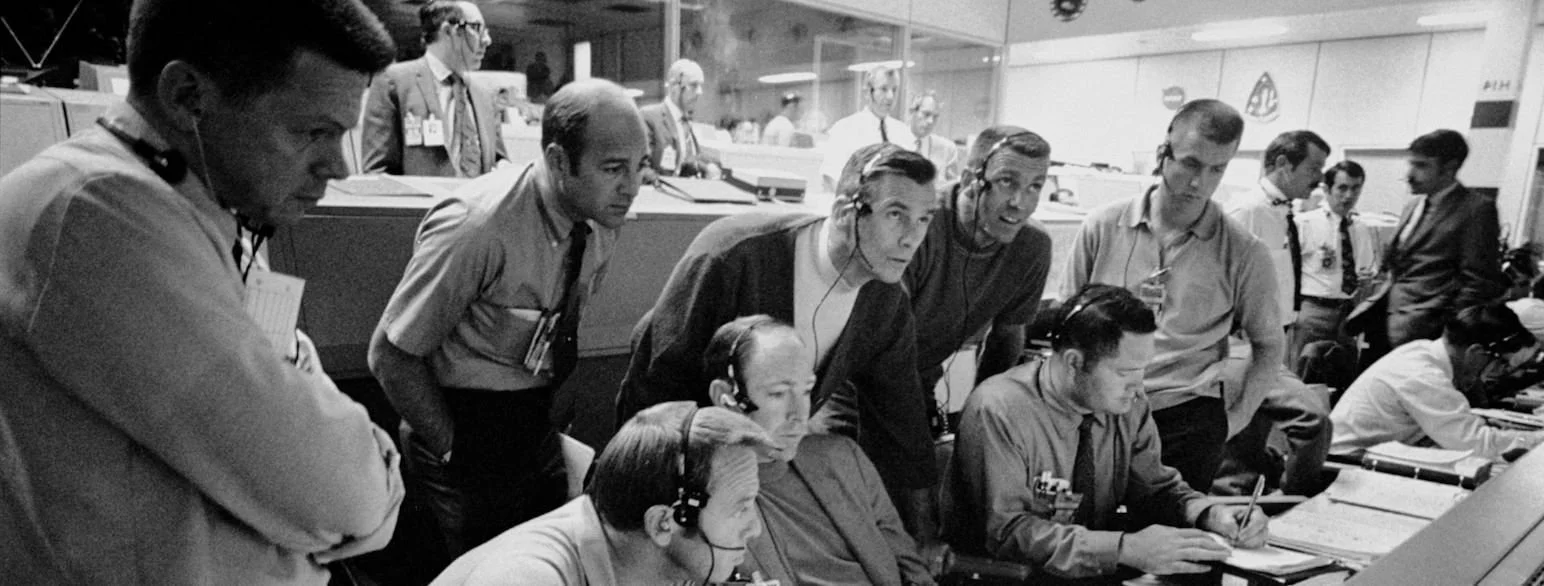
April 14, 1970: Six astronauts and two flight controllers in NASA’s Mission Control in Houston monitor the Apollo 13 crew’s return to Earth. Photo: NASA.
Vision inspires. Coherence compounds.
Every era asks something different of its leaders.
Industrial organizations demanded the ability to marshal capital, labor, and infrastructure at unprecedented scale. The information age shifted the challenge toward knowledge, communication, and speed. Today, artificial intelligence is changing the landscape once again. Information has become abundant. Ideas can be generated in seconds. Analysis that once required weeks now happens almost instantly.
Yet despite these extraordinary advances, many organizations feel less aligned than ever.
Products multiply. Teams become more specialized. Decisions accelerate. New technologies promise greater efficiency, but often introduce greater complexity. Organizations are moving faster, but not always together.
The defining challenge of the AI era is no longer generating information. It is creating and sustaining coherence.
Modern organizations rarely suffer from a lack of vision. Executive teams invest enormous energy defining strategy, articulating purpose, and describing ambitious futures. Most can clearly explain where they are going.
The greater challenge begins after the strategy is announced.
As organizations grow, functions specialize, markets evolve, product portfolios expand, and decision-making becomes increasingly distributed. Product teams optimize for innovation. Marketing refines positioning. Sales responds to customer demand. Operations pursues efficiency. Customer Success adapts to realities on the ground.
Each decision often makes perfect sense in isolation.
Collectively, however, those decisions can gradually pull an organization in different directions. Customers experience inconsistency. Employees become uncertain about priorities. Leadership begins spending more time restoring alignment than creating momentum.
Vision, it turns out, is necessary but insufficient.
Vision provides direction.
Coherence allows an organization to move in that direction together.
Much of the current conversation around artificial intelligence focuses on productivity. AI can summarize research, generate content, write software, analyze markets, and accelerate execution at extraordinary speed. These capabilities are genuinely transformative.
They also change the nature of executive leadership.
When information becomes abundant, it ceases to be the primary source of competitive advantage. The scarce resource becomes judgment. More specifically, it becomes an organization’s ability to exercise judgment collectively, allowing thousands of individual decisions to reinforce a common direction rather than fragment it.
AI amplifies whatever already exists.
In coherent organizations, it accelerates learning, execution, and innovation. In fragmented organizations, it accelerates fragmentation. It produces more content, more decisions, and more activity without necessarily creating greater clarity.
Technology is rarely the limiting factor.
Leadership increasingly is.
This is why I have come to think of coherence not as a communications challenge, but as a leadership discipline.
Communication explains decisions.
Coherence shapes them.
It is the ongoing work of ensuring that strategy, culture, incentives, leadership behavior, operating models, customer experience, and execution continually reinforce one another. It cannot be achieved through a single strategy off-site or an annual planning process. It is cultivated through hundreds of conversations, trade-offs, and decisions that gradually create shared understanding across an organization.
Every hiring decision, every partnership, every product roadmap, every investment, and every executive conversation either strengthens coherence or weakens it.
The organizations that sustain coherence over time develop a remarkable characteristic. Independent decisions made throughout the business begin to reinforce one another without constant executive intervention. People understand not only what the organization is trying to accomplish, but why. They develop the judgment to make decisions that support the whole rather than simply optimize their individual function.
Looking back across my own work, I have become increasingly convinced that this challenge transcends industry.
Whether working with luxury retailers, cultural institutions, universities, technology ventures, or complex real estate developments, the underlying question has remained remarkably consistent. How do you help diverse groups of people move together? How do you align culture, strategy, systems, and leadership so that an organization behaves as a coherent whole rather than a collection of competing priorities?
The industries have changed.
The leadership challenge has not.
Perhaps that is why coherence increasingly feels like the defining capability of executive leadership in the age of AI. Not because it replaces vision. Because it allows vision to survive contact with reality.
Organizations will continue to compete through innovation. They will continue to invest in technology. They will continue to pursue growth. The organizations that endure, however, will be those that create coherence around those ambitions. They will build cultures where strategy, leadership, products, customer experience, and technology reinforce one another over time.